
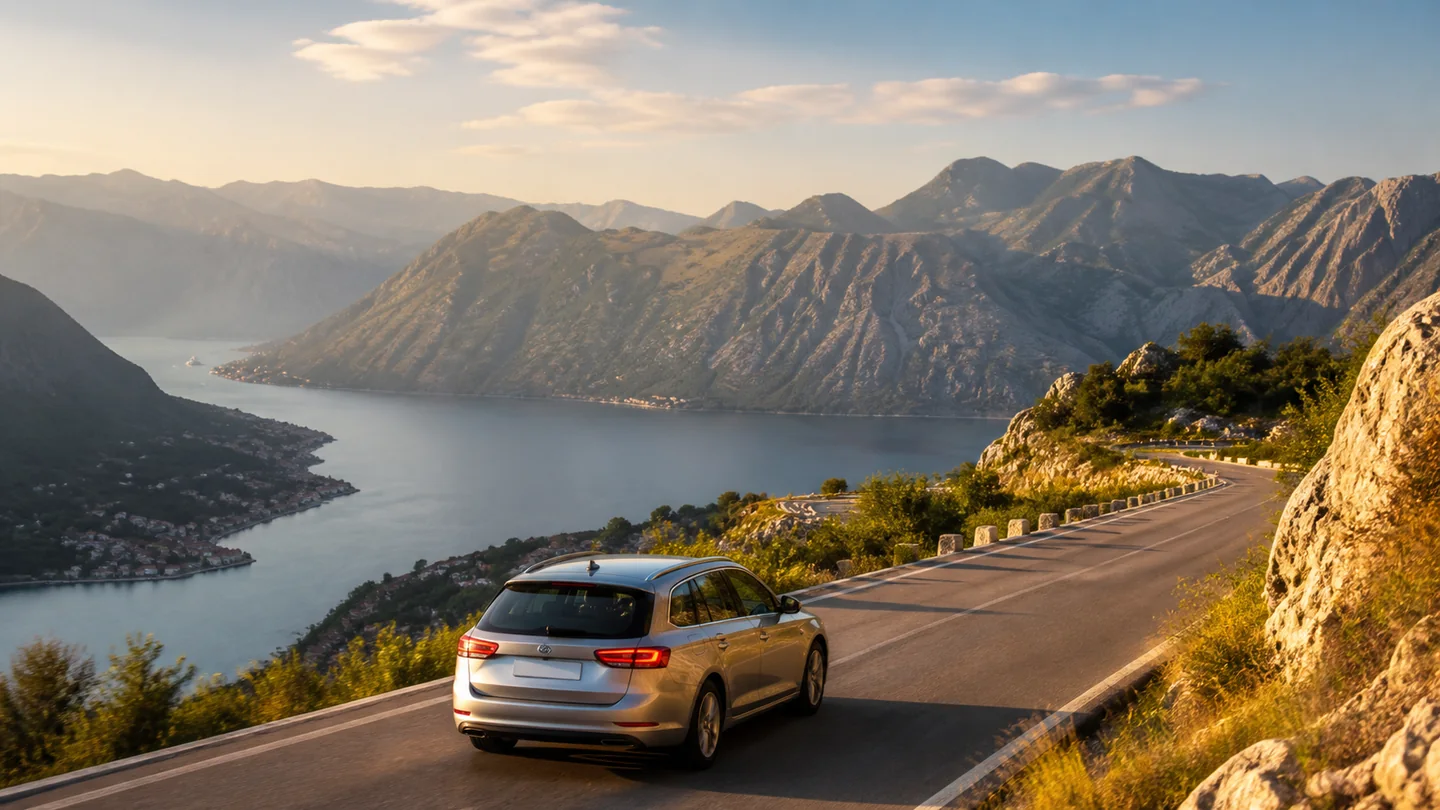
Why seven days works—and what not to squeeze in
Seven days is enough to connect Montenegro's Adriatic coast, historic towns, lake country and northern mountains, but only if the itinerary respects the roads. Short map distances can include coastal queues, tunnels, bends, parking searches and viewpoint stops. A good plan uses two-night bases where possible and one main transfer per day. It does not attempt every beach, monastery and mountain road before dinner.
This route begins near Tivat and Kotor, moves through Budva and Cetinje to Lake Skadar, continues north through Kolašin to Durmitor, and finishes near Podgorica. It can be reversed for different flights. Check the current rental fleet, choose a vehicle that fits people and luggage, and enter the real pickup and return cities so location charges are included from the start.
Before day one: airport and vehicle choice
Tivat Airport is normally the practical arrival for Kotor Bay, while Podgorica Airport often suits Lake Skadar and northern routes. Arriving through Tivat and departing through Podgorica creates an efficient open itinerary when a one-way arrangement is available. If flights require the same airport, the route can become a loop, but the final day needs more transfer time.
For two travellers with moderate luggage, a compact automatic is often sufficient on principal paved roads. Families should count suitcases as well as seats. Confirm air conditioning, transmission, child seats and seasonal tyre needs. Under the standard confirmed terms there is no deposit, no credit-card block and no kilometre limit; responsible use and the written agreement still apply.
Day 1: Tivat Airport to Kotor Bay
Send the flight number before arrival and follow the confirmed handover instructions. After checking the vehicle, controls, fuel and recorded condition, make the first drive deliberately short. Travel to the accommodation around Kotor Bay, park once and settle in. Do not schedule a remote mountain transfer immediately after a flight, especially after dark or with tired children.
If time and energy allow, walk Kotor Old Town or the waterfront rather than moving the car between nearby sights. Confirm accommodation parking before arrival; ‘parking available’ may refer to a public facility rather than a reserved space. The Kotor car-rental guide explains delivery and local planning.
Day 2: Kotor, Perast and the bay
Use the second day for the bay instead of changing hotels. Leave early for Perast, use a legal signed parking area and continue only if traffic and weather make the plan comfortable. Boat activities are separate from the rental; follow the operator's instructions and leave enough time to return to the parked vehicle before any facility closes.
The bay road rewards patience. It is narrow in places and passes settlements where pedestrians and local access matter more than speed. Do not stop in a traffic lane for photographs. A safe pull-off or official viewpoint is worth waiting for. Returning to the same base removes luggage handling and gives flexibility if cruise or summer traffic is heavier than expected.
Day 3: Kotor to Budva, with an optional coast stop
The Kotor–Budva distance looks small, but summer queues can make the transfer unpredictable. Start with fuel and leave a margin for the Tivat junction and beach traffic. If stopping at a viewpoint or coastal village, choose one meaningful stop rather than repeatedly searching for parking. Keep luggage out of sight and never leave passports or electronics visible.
In Budva, confirm the exact parking arrangement before entering a crowded neighbourhood. Once parked, the Old Town and waterfront are best explored on foot. The listed Budva centre and bus-station delivery zone currently has no city charge, while Kotor has a €20 city-zone charge. Review the Budva pickup and delivery page.
Day 4: Budva, Cetinje and Lake Skadar
Leave the coast for Cetinje, Montenegro's historic royal capital, then continue toward the Lake Skadar area. Choose established roads and follow current signs rather than a shortcut suggested only because it is shorter. The landscape changes quickly from busy coast to limestone interior, so allow time for viewpoints without turning the day into a race.
Virpazar is a common base for lake activities, but parking and boat arrangements should be confirmed separately. If you plan a boat trip, do not set a tight onward drive immediately after it. Overnight near the lake or continue to Podgorica depending on accommodation and daylight. The objective is to reach the evening base calm enough to enjoy it.
Day 5: Lake Skadar or Podgorica to Kolašin
Begin northbound after checking fuel, weather and the day's route. The main corridor toward Kolašin includes tunnels and changing elevation. Keep a safe following distance and expect conditions to differ from the coast. Navigation time should be treated as a baseline, not a deadline. Stop only in designated areas and never at a tunnel entrance or blind bend.
Kolašin is a useful transition base before Durmitor. Arriving with daylight leaves time to check the next day's conditions and rest. A larger SUV is not automatically required for normal principal paved roads; the right vehicle depends on season, luggage and confirmed route. Ask about tyre requirements for the dates rather than relying on a general summer photograph.
Day 6: Kolašin to Žabljak and Durmitor
Travel toward Žabljak with a flexible plan. Mountain weather can reduce visibility and seasonal restrictions can affect scenic roads. Use recognised routes, obey closures and set a turnaround time. Durmitor should not be treated as a checklist completed from the driver's seat. Park legally, choose one or two activities and leave room for conditions to change.
The official Montenegro tourism site identifies panoramic routes including the Durmitor Ring, but a promoted scenic road still requires current local checks, suitable weather and a confident driver. Download an offline map and finish unfamiliar high sections in daylight. The Durmitor driving guide provides additional preparation advice.
Day 7: Žabljak to Podgorica and departure planning
If the flight departs late, leave Žabljak with a large margin for weather, roadworks, fuel and the handover. For an early flight, spend the previous night closer to Podgorica instead of gambling the holiday on a dawn mountain transfer. The final day is not the place for an unplanned scenic detour. Confirm the return point and time before setting off.
Refuel according to the agreement at a practical station, check the cabin and boot for personal items and photograph the vehicle after parking. Podgorica's current city-zone charge is €20. If the car was collected in Tivat, its €15 charge combines with Podgorica for a €35 location total. Read the Podgorica Airport return guide.
Alternative route for a Podgorica return flight
Travellers flying both ways through Podgorica can start with Lake Skadar, continue to the coast, spend two nights around Kotor, then turn north through Kolašin and Durmitor before returning to the capital. The route covers similar ground but requires careful sequencing. Avoid crossing the same congested coast section at peak time simply to preserve a rigid list.
If both flights use Tivat, reverse the northern section and allow a full final transfer back to the bay. Whichever loop you choose, place the last night according to departure time. One-way convenience should be compared with city charges and flight prices as a complete plan, not as isolated numbers.
Parking strategy for Kotor, Budva and the mountains
Historic centres are walking destinations. Ask each accommodation for the exact parking address, whether the space is guaranteed, how it is accessed and what it costs. Use marked municipal or private parking and retain tickets. An empty roadside area is not automatically legal. Save the vehicle location on the phone and photograph payment-zone instructions if the expiry time is easy to forget.
In mountain areas, do not block gates, local access or narrow roads for a photograph. Use designated viewpoints and trail parking. Weather can make an informal verge soft or unsafe. Remove valuables from sight everywhere, close windows and check that the vehicle is locked. A compact car may simplify parking, but it still needs to fit all luggage safely.
Fuel, tolls, phones and daily checks
Confirm the correct fuel at handover and fill before remote stages. Keep the final fuel receipt if the return procedure requests it. Some infrastructure, including the Sozina route when used, may involve a charge; follow current signs and carry a payment card plus some euro cash. Prices and payment systems can change, so do not build the budget from an old screenshot.
Download offline maps, keep water and charge phones, but never operate navigation while driving. Each morning, walk around the car, inspect the tyres visually, clear windows and check for a warning. If a serious light appears, stop safely and call the rental team. Guessing is not part of a good road trip.
What to pack and what to leave out
Pack layers for the difference between coast and mountain, comfortable walking shoes, water, charging cables and copies of key confirmations stored securely offline. Bring the original driver and travel documents, not only phone images. Keep luggage volume realistic for the selected vehicle and request a child seat in advance with the relevant age or specification.
Leave out a minute-by-minute schedule. Montenegro is better when the plan can absorb a traffic queue, sudden cloud or a longer lunch. Do not add Bosnia, Albania or Dubrovnik casually to this seven-day route; foreign travel needs prior approval, prepared documents, an eligible duration and the €20 charge for each day abroad.
Budgeting the rental honestly
Compare the full vehicle price for actual dates and duration, not only the first advertised daily rate. Add the confirmed city delivery, fuel, parking, possible road charges, child seats and approved foreign days. Under standard terms, no deposit or card hold removes a major cash-flow uncertainty, while unlimited mileage means the route does not generate an excess-kilometre bill.
Season and availability still affect the vehicle rate. Summer duration bands can differ from fixed quieter-season pricing. Enter exact pickup and return hours because an additional rental day may result from timing, not distance. The booking form is more reliable than manual arithmetic based on an old image.
Seven-day booking checklist
Confirm flights, operating flight number, first and final accommodation, pickup and return cities, dates, hours, passengers, luggage, transmission, child seats and additional drivers. Check the vehicle category and the complete location total. Save contact details and confirmation offline. If the weather changes, preserve the overnight structure and remove an activity rather than driving faster.
Begin with the Montenegro Rent a Car reservation search, compare the vehicle options and use contact and support for a route-specific question. A successful seven-day road trip is not the itinerary with the most pins; it is the one that leaves enough time to experience each region safely.
Sources and review date
This itinerary was reviewed on 31 August 2026. Route sequence and rental procedures reflect the information available at that date, but road conditions, park access, payment rules and weather can change. Follow current signs, closures, police instructions and the written rental agreement. Confirm time-sensitive information before every mountain stage.
For trip planning, consult the official Montenegro panoramic roads information and Airports of Montenegro. Official promotion describes possibilities; the day's actual road, weather and safety conditions determine what should be driven.