
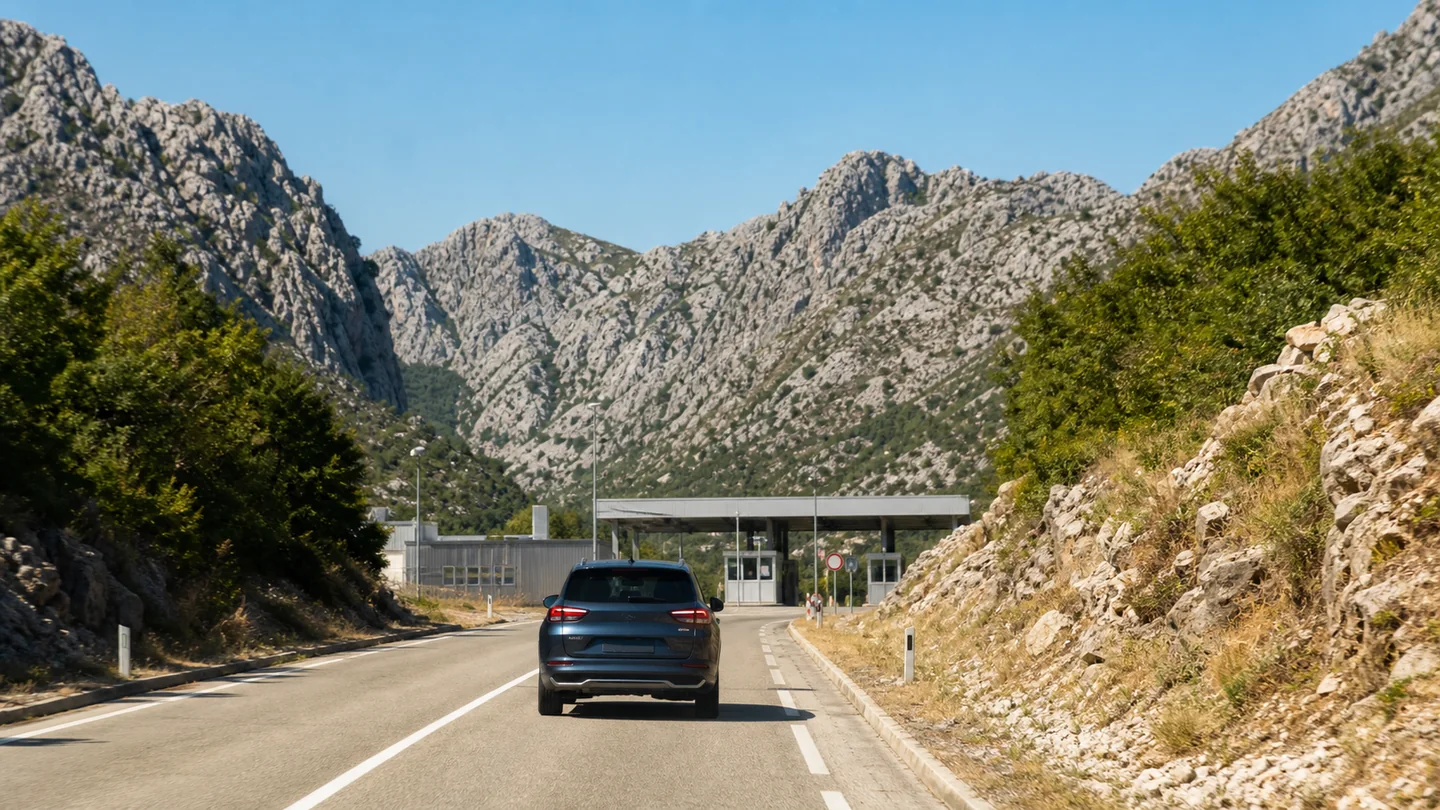
The short answer: yes, with advance approval
An eligible Montenegro Rent a Car vehicle can be authorised for one destination option among Albania, Bosnia and Herzegovina or the Dubrovnik route in Croatia. Permission is not automatic and cannot be inferred from the fact that the traveller is personally allowed to cross the border. The rental company must approve the territory for the specific vehicle and dates, then prepare the required vehicle documentation before departure.
Declare the plan during reservation whenever possible. If the itinerary changes later, notify the team before the rental or before leaving Montenegro and wait for written confirmation. Do not arrive at a checkpoint and request permission from the queue. A border officer examines the documents carried at that moment; a last-minute message cannot replace papers that should have been prepared in advance.
Only one foreign destination option per rental
The current company rule allows one selection: Bosnia and Herzegovina, Albania, or Dubrovnik/Croatia. A route that tries to combine two or three of these countries in the same rental falls outside the standard permission. State the exact destination, expected foreign dates and intended crossing direction so the team can assess whether the vehicle and rental period are eligible.
This restriction matters when planning a circular Balkan itinerary. Do not reserve non-refundable hotels in several countries before the vehicle permission is confirmed. If a multi-country route is essential, ask whether a different arrangement exists, but treat it as unavailable until explicitly approved. The booking form and written response, not a generic travel blog, govern the car's permitted territory.
How the €20 foreign-day charge is calculated
The additional charge is €20 for every calendar or rental day the vehicle spends outside Montenegro according to the confirmed calculation. Days spent entirely inside Montenegro do not receive the foreign-day charge. For example, a seven-day rental with two approved days in Albania adds €40 for foreign use, not €140. Provide realistic exit and return dates so the total and documents match the plan.
The foreign-day charge is separate from the vehicle price and any pickup or return city fee. It covers the approved cross-border arrangement; it does not pay border tolls, parking, fuel, visas, personal travel documents or fines. Review the itemised confirmation rather than multiplying a daily car price and assuming every other service is included.
Minimum rental duration and the Kotor rule
Cross-border use is available only when the rental meets the active minimum duration. The standard rule requires a rental longer than three days. Seasonal and location conditions can be stricter; for Kotor, a minimum of five rental days may apply until October for a foreign journey. The live reservation rule and written confirmation take priority if dates or operational conditions change.
Do not extend dates artificially and plan to return early. Duration rules reflect vehicle preparation, document work and delivery logistics, and an unreported change can invalidate the approved plan. Enter the real dates, pickup point and return point. If the website displays a minimum-duration warning in your language, adjust the actual itinerary or contact the team rather than trying to bypass it.
Driver and vehicle documents
The authorised driver should carry the original driving licence accepted for the reservation, passport or accepted identity document, rental agreement and the vehicle documents supplied at handover. Depending on the approved route, an authorisation or insurance evidence may also be prepared. Check the names, vehicle details, territory and validity dates before leaving the pickup point.
Every traveller remains responsible for passport, visa, residence and entry requirements. Rental permission for the car is not a visa for the people inside it. Requirements vary by nationality and can change. Use the relevant government or consular source for each traveller instead of relying on the experience of somebody with a different passport. Keep original documents accessible but secure throughout the journey.
Insurance and territorial limits
Ask in writing which cover applies in the approved destination, which incidents or vehicle parts may be excluded and what procedure must be followed after damage or theft. An insurance label used for driving in Montenegro does not automatically explain the position abroad. An unauthorised driver, country, road type or late report can affect protection even when the border crossing itself was physically possible.
Before departure, save the emergency and rental contacts offline. If an incident occurs, prioritise safety, contact local authorities when required and inform the rental team promptly. Do not agree privately to pay another party or move a visibly unsafe vehicle without appropriate instruction. Retain police papers, photographs and receipts requested under the confirmed procedure.
Montenegro to Albania
For an approved Albania route, the commonly relevant official road crossings include Božaj–Hani Hotit for the Podgorica–Shkodër direction and Sukobin–Murićani for the Ulcinj–Shkodër direction. The best choice depends on the starting point, destination and current conditions, not only the map distance. Official status, opening conditions and police instructions must be checked near travel time.
Allow time for summer queues and avoid committing to a fixed tour immediately after the estimated crossing. Confirm mobile roaming, fuel and parking arrangements for Albania separately. The rental authorisation concerns the vehicle; it does not guarantee road conditions or entry. The Government of Montenegro publishes the official border-crossing list.
Montenegro to Bosnia and Herzegovina
Bosnia and Herzegovina has several official road connections with Montenegro. Routes toward Trebinje commonly use the western crossings, while journeys toward Foča and Sarajevo can use different mountain corridors. A navigation application may suggest a route that is unsuitable for the time, weather or vehicle. Confirm the approved destination and use a recognised passenger crossing shown by current official information.
Mountain approaches can include narrow sections and variable surfaces. Add daylight and weather margins, especially outside summer. Fill fuel before remote stretches and do not treat an apparently short kilometre distance as a guaranteed travel time. The Ministry of Interior's information service and live views can help assess selected crossings, but signs and officers at the location remain authoritative.
Montenegro to Dubrovnik and Croatia
The usual road direction from Herceg Novi toward Dubrovnik uses the Debeli Brijeg–Karasovići crossing. Seasonal queues can be substantial because the route serves coast traffic as well as airport and day-trip journeys. Build a generous margin before a Dubrovnik accommodation check-in, airport departure or vehicle return. A map estimate without border waiting time is not a reliable appointment time.
Approval to visit Dubrovnik does not mean the car may be returned in Croatia. Unless a separate written arrangement says otherwise, the vehicle must be returned at the confirmed Montenegro location. Ferry, toll, parking and low-emission or local access rules encountered abroad remain the traveller's responsibility. Keep the rental documents ready before reaching the control point.
Checking queues and current crossing information
Montenegro's Ministry of Interior provides camera views for selected routes toward Albania, Bosnia and Herzegovina, Serbia and Croatia. These images can improve timing decisions but cannot promise how quickly the queue will move after the image was captured. Weather, document checks, traffic volume and incidents can change conditions rapidly.
Use the official border camera service before departure and again when safely stopped near the route. Never use a phone while driving. Avoid unofficial shortcuts or a crossing intended only for limited local traffic. The prepared permission should match an appropriate official passenger crossing.
Vehicle choice, fuel and roaming
Select the car by passengers, luggage, transmission and route. A compact car is often easier in historic towns, while a larger category may be justified by luggage rather than the border itself. Check the available Montenegro rental cars and place essential features in the notes. A larger car does not make a narrow mountain road safer without careful driving.
Confirm petrol or diesel and identify practical fuel stops on both sides of the border. Download offline maps, save accommodation details and check that the driver's phone will roam. Carry water and a charging cable. These small preparations reduce the temptation to stop unsafely or follow an unsuitable shortcut when data disappears.
Pickup, return and one-way city charges
Cross-border approval is separate from Montenegro city delivery. Podgorica currently has a €20 city-zone fee, Tivat €15, Kotor €20, the listed Budva centre and bus station are free, and Bar Train Station is €20. A pickup and return within one city uses that city charge once; different cities are added together. Podgorica pickup and Tivat return therefore results in €35 in city charges.
A one-way return inside Montenegro can make a foreign route more efficient, subject to availability. Read the Montenegro one-way car-rental page. Do not assume that cross-border use permits an international one-way return. Return country and location must be explicitly stated in the confirmation.
Cross-border booking checklist
Send the foreign destination, exit date, return-to-Montenegro date, full rental dates, pickup and return points, lead driver, additional drivers and reachable phone. Confirm the rental is long enough, the €20 foreign-day calculation is correct, only one destination has been selected and the required vehicle documents will be supplied. Save the written approval offline.
At handover, inspect the car, verify the fuel rule, review the incident procedure and check the prepared papers. Before travel, verify personal entry requirements and current crossing conditions. If the route changes, ask before acting. Start through the reservation search or send the complete plan via contact and support.
Review date and reliable sources
This guide was reviewed on 31 August 2026. Company fees, permitted destination options and duration rules describe the current configured policy and must be reconfirmed for the selected vehicle and dates. Border status, immigration requirements and road conditions are controlled by public authorities and can change independently of the rental company.
Use the Government of Montenegro's official crossing list, the Ministry of Interior border information and its camera service for current checks. Written rental approval and current official instructions together define a properly prepared journey.
Border-day checklist before leaving Montenegro
Reconfirm written permission, the approved destination and the foreign-travel dates with the rental team. Place the original vehicle documents, rental agreement, passport and driving licence where the driver can reach them without unpacking the car. Check fuel, tyres, lights, mobile roaming and offline maps. Save the rental contact and the emergency number, but never stop in a traffic lane to search for a document. Every passenger should know that border officials may ask questions and that processing time can change without warning.
Use an official crossing suitable for the route and current operating conditions. Navigation applications can suggest a minor road that is attractive on a map but unsuitable for an international crossing or a rental agreement. The Government of Montenegro publishes the recognised border points, while live camera information can help identify congestion. These services support planning; they do not guarantee a fixed waiting time or replace instructions from border authorities.
Returning to Montenegro after the foreign stage
Keep the documents available for the return crossing and tell the rental team promptly if a closure or long queue changes the schedule. Do not add another country simply because it appears faster. Permission applies to the agreed option, vehicle and period. Once back in Montenegro, check the route to the return location and allow for coastal traffic, fuel and the final inspection. A late international arrival can affect both the representative and the next guest.
If an incident occurred abroad, do not wait until return to mention it. Follow the local authority procedure and contact the rental team from a safe place. Keep the police record, photographs and other documents requested under the agreement. Private roadside arrangements can create uncertainty about responsibility and cover. Immediate reporting is usually the clearest way to protect the travellers, the vehicle and the validity of the paperwork.
When a Montenegro-only itinerary is the better choice
A foreign detour is not automatically a better holiday. Montenegro already combines the Bay of Kotor, Adriatic beaches, Lake Skadar, mountain parks and historic towns within a compact area. If the rental is short, crossing a border may exchange valuable sightseeing time for queues and repeated packing. A seven-day trip can easily remain inside Montenegro and still feel varied, especially when Kotor, Budva, the lake and Durmitor are arranged in a sensible order.
Choose the international route when the destination genuinely matters and there is enough time for delays. Choose a domestic loop when the main goal is a relaxed Montenegro journey. In both cases, send the real plan before confirmation. Transparent permission, realistic timing and the correct documents matter more than the number of borders on the itinerary.